

If you manufacture or distribute pipes, steel profiles, aluminum extrusions, wooden boards, or any elongated product, you've probably faced this challenge: how do you wrap something that's 3, 6, or 12 meters long?
Standard vertical pallet wrappers are designed for box-shaped loads on pallets. They simply cannot handle long, continuous products. The result? Most manufacturers resort to manual wrapping—workers walking along the length of the product, hand-applying film or paper. This is slow, wasteful, inconsistent, and potentially dangerous (workers tripping over long products in confined spaces).
The horizontal stretch wrapper was invented to solve exactly this problem. And for pipe mills, steel service centers, aluminum extruders, and wood processors, it has become an essential piece of packaging equipment.
What Is a Horizontal Stretch Wrapper?
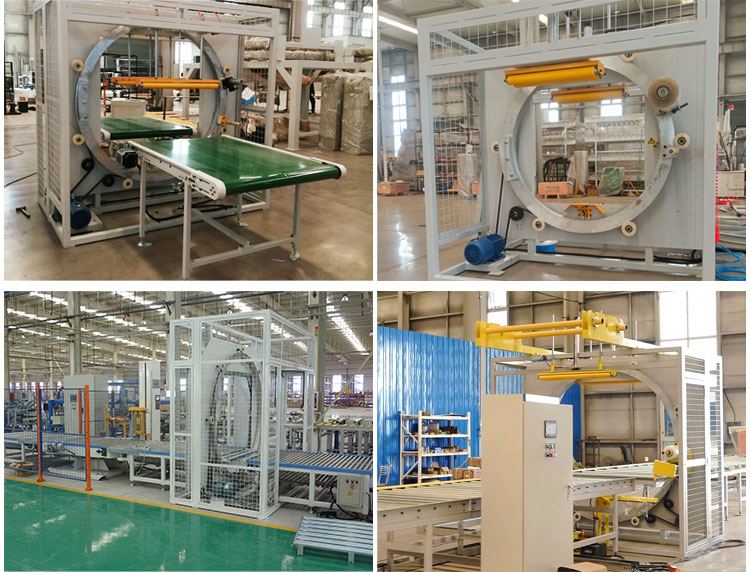
A horizontal stretch wrapper feeds long products horizontally through a rotating ring. As the product moves through the ring, the ring spins continuously, wrapping film, paper, or woven fabric around the product in a spiral pattern. The result is complete 360° surface coverage with consistent tension and overlap.
Think of it as the reverse of a vertical wrapper: instead of the product spinning on a turntable, the wrapping ring spins around the product as it passes through.
Key components:
• Rotating ring with film holder
• Motorized product feed conveyor
• PLC control system
• Automatic film cutting and positioning
• Optional loading/unloading conveyors
Why Manual Wrapping of Long Products Is Costing You Money
Let's look at the real costs of manual wrapping for a typical pipe or profile operation:
Labor Costs
A typical manual wrapping team requires 2 workers—one at each end of the product, walking back and forth applying film. At
1,600–2,400/month in labor alone. Over a year, that's $19,200–28,800 just for wrapping labor.
Material Waste
Manual wrapping is inherently wasteful. Workers tend to overlap excessively to ensure coverage, using 30–50% more film than necessary. Inconsistent tension means some areas are over-wrapped while others are under-protected, leading to damage claims.
Damage and Complaints
Without consistent film tension and complete coverage, surface damage (scratches, corrosion, moisture stains) is common. For polished stainless steel tubes or anodized aluminum profiles, even minor surface defects can result in customer rejection and costly returns.
Safety Risks
Workers wrapping long products manually face trip hazards, repetitive strain injuries, and exposure to film dust. Workplace injury claims related to packaging operations are more common than most manufacturers realize.
The Horizontal Wrapper Solution: How It Works
Step 1: Loading
Products are loaded onto a motorized feed conveyor (manually or automatically). For high-volume operations, automatic loading systems with chain conveyors or roller tables are recommended.
Step 2: Wrapping
The product is fed through the rotating ring at a controlled speed (6–12 m/min). The ring rotates at 19–57 RPM, applying the packaging material in a tight spiral with consistent overlap. The PLC controls the exact number of layers and overlap percentage.
Step 3: Cutting
At the end of the cycle, the film is automatically cut and the end is secured. No manual intervention required.
Step 4: Unloading
The wrapped product exits the machine and is collected for stacking, bundling, or direct shipment.
Total cycle time for a 6-meter pipe: approximately 30–60 seconds, depending on the number of layers required. This compares to 3–5 minutes for manual wrapping of the same product.
6 Key Factors When Choosing a Horizontal Wrapper
1. Product Dimensions
Know your maximum and minimum product cross-section. The SP1000 handles products with width 300–650 mm and height 350–650 mm. If your products fall outside this range, you need a custom-sized machine.
2. Product Weight
Consider both individual product weight and total throughput. The SP1000 handles up to 1,000 kg per product. For heavier items, the conveyor system and ring structure must be reinforced.
3. Packaging Material Type
Different products require different packaging materials:
PE stretch film: Best for moisture and dust protection (most common)
Woven fabric: Best for heavy-duty abrasion resistance during transport
Paper: Best for surface-sensitive products (polished metals, anodized aluminum)
Ensure the machine supports your required material type and width (100–300 mm).
4. Speed and Throughput
Ring rotation speed (19–57 RPM) and product feed speed (6–12 m/min) determine your throughput. For high-volume operations, prioritize higher speeds and consider automatic loading/unloading systems.
5. Integration with Existing Lines
If you're adding wrapping to an existing production line, the horizontal wrapper must match your line speed and conveyor layout. Discuss integration requirements with the manufacturer before purchasing.
6. After-Sales Support
Horizontal wrappers are more complex than standard turntable machines. Ensure the manufacturer provides:
Remote technical support
Video installation guides
Spare parts availability
Optional on-site installation and training
Common Mistakes to Avoid
1. Choosing the wrong ring size. The ring must accommodate your largest product cross-section with adequate clearance. Too small = products won't pass through. Too large = excessive film waste and poor wrap quality.
2. Ignoring material compatibility. Not all films work with all products. Corrosive metals may react with certain film adhesives. Always test material compatibility before committing to a wrapping system.
3. Underestimating conveyor requirements. The feed conveyor must be precisely aligned with the ring center. Misalignment causes uneven wrapping and film breaks.
4. Skipping the pre-stretch system. Machines without pre-stretch waste 30–50% more film. Over a year, the film savings from pre-stretch alone can pay for this feature.
5. Not planning for future growth. If your product range may expand, choose a machine with adjustable ring sizes or plan for a second machine. Retrofitting is always more expensive.
The Bottom Line
For any manufacturer producing long, continuous products, a horizontal stretch wrapper is not a luxury—it's a necessity. It eliminates the labor, waste, inconsistency, and safety risks of manual wrapping while delivering professional, consistent packaging quality.
The SP1000 from Dyehome offers ring speeds up to 57 RPM, PLC automation, and compatibility with PE film, woven fabric, and paper wrapping materials. With a typical payback period of 8–14 months, the investment pays for itself quickly through labor savings, material efficiency, and reduced damage claims.
Become Our Authorized Distributor
Dyehome is expanding its global partner network. We are seeking distributors, system integrators, and automation partners in key markets worldwide.
Partner Benefits:
Factory-direct pricing with attractive margins
Full product range: turntable, rotary arm, inline, horizontal, cylinder, and top-cover wrappers
Complete marketing support: brochures, videos, case studies, technical documentation
Comprehensive technical training and after-sales support
OEM/ODM customization available
21 years of manufacturing excellence