

If you manufacture or distribute products in roll form—fabric rolls,paper rolls,rubber rolls,cable reels,plastic film rolls—you know the packaging challenge is fundamentally different from wrapping boxes on pallets.
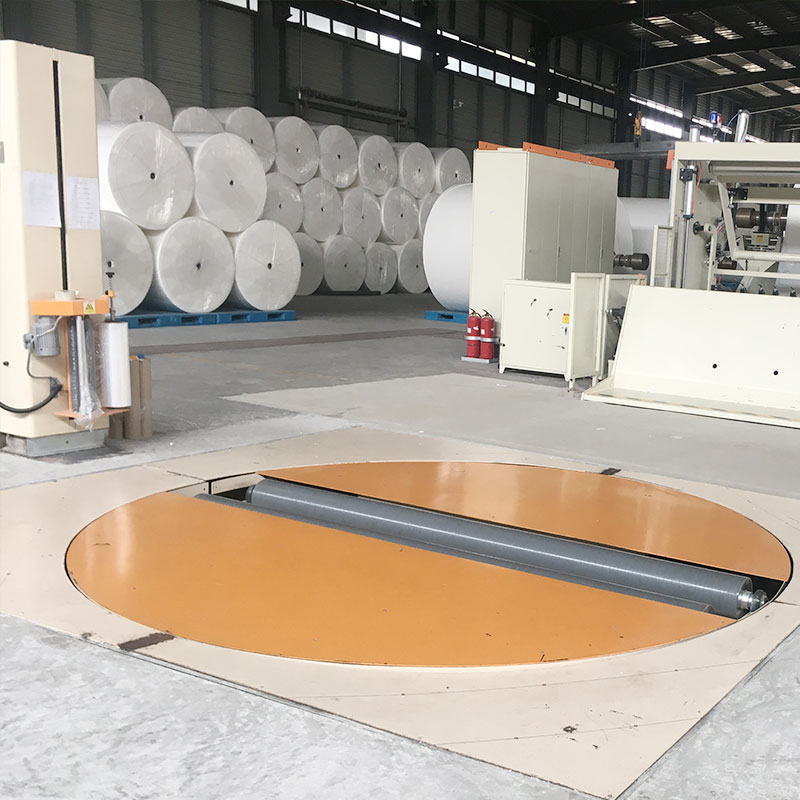
Cylindrical products roll.They deform under pressure.Their surfaces are sensitive to scratches,dents,and moisture.And they come in a wide range of diameters and widths that don't fit on standard pallet wrappers.
Most manufacturers still wrap rolls by hand or with makeshift equipment.The results are predictable:inconsistent wrap quality,excessive film use,surface damage from improper handling,and labor-intensive processes that bottleneck production.
The cylinder rotary stretch wrapper was designed specifically to solve these problems.And for roll-intensive industries,it has become as essential as the production line itself.
What Is a Cylinder Stretch Wrapper?
A cylinder stretch wrapper is a specialized wrapping machine that holds cylindrical products(rolls,coils,reels)in adjustable cradles on a rotating turntable.As the turntable spins,stretch film is applied uniformly around the cylindrical surface,creating a complete protective layer.
Unlike horizontal wrappers(which feed long straight products through a ring),cylinder wrappers rotate the product itself on a cradle-style turntable.This design accommodates the full range of roll diameters and widths while keeping the roll axis horizontal and stable.
The Dyehome HYP2000F-AU represents the latest generation of cylinder wrappers:
Wrapping diameter:600–1,500 mm
Wrapping width:700–3,050 mm
Turntable options:2,000–3,400 mm diameter
Pneumatic auto-ejection system
PLC fully automated control
10–30 rolls per hour throughput
The True Cost of Manual Roll Wrapping
Let's quantify what manual wrapping actually costs a typical roll-production facility processing 500 rolls per month:
Labor
Manual roll wrapping requires 2 workers(one at each end of the roll,applying and tensioning film).At 1,600–2,400/month**just for wrapping labor.Annually:$19,200–28,800.
Film Waste
Workers consistently over-apply film when wrapping manually because they can't maintain consistent tension.Studies show manual wrapping uses 40–60%more film than machine wrapping with pre-stretch.For a facility spending 240–600/month in waste.
Surface Damage
Rolls wrapped manually have uneven tension,leading to loose areas where the film peels off during transit.The exposed surface picks up moisture,dust,and scratches.Damage rates for manually wrapped rolls typically run 2–4%of production—each damaged roll represents lost material,rework cost,and potential customer claims.
Handling Injuries
Manually wrapping heavy rolls(200–1,500 kg each)requires workers to lean over,bend,and reach around large cylindrical loads.Back injuries and shoulder strain are common.Workers'compensation claims related to manual wrapping add hidden costs.
How a Cylinder Wrapper Solves These Problems
Automatic,Consistent Wrapping
The PLC controls the entire cycle:load→detect roll size→wrap with programmed layers and tension→cut film→eject.Every roll gets identical wrap quality regardless of operator skill or shift timing.
Pre-Stretch Film Savings
The 1:2.5(250%)pre-stretch system stretches film to 2.5 times its original length before application.This alone saves 30–50%on film costs.For a facility spending 180–300/month**in savings—or$2,160–3,600/year.
Gentle Handling
The cradle-style turntable supports the roll along its full length,preventing deformation.The pneumatic ejection system lifts the roll after wrapping,eliminating manual lifting of heavy loads.No more bending,reaching,or straining.
Speed
The HYP2000F-AU wraps 10–30 rolls per hour,compared to 4–8 rolls per hour for manual wrapping.That's a 2.5–4x productivity improvement.
6 Key Factors When Choosing a Cylinder Wrapper
1.Roll Diameter Range
Know your minimum and maximum roll diameter.The HYP2000F-AU handles 600–1,500 mm.If your rolls fall outside this range,you need a custom model.Always size for your largest roll,not your average.
2.Roll Width(Length)
Roll width determines the machine's cradle span and required turntable size.The HYP2000F-AU supports widths from 700 mm to 3,050 mm.Measure your maximum roll width including any flanges or cores that extend beyond the material.
3.Roll Weight
Each roll must sit securely on the cradle without overloading it.The HYP2000F-AU supports up to 1,500 kg.For heavier rolls,the cradle structure and turntable bearings must be reinforced.
4.Turntable Diameter
The turntable must be large enough that the roll doesn't overhang during rotation.As a rule of thumb,the turntable diameter should be at least 1.3x the roll diameter.The HYP2000F-AU offers 6 turntable size options(2,000–3,400 mm)to match your roll sizes.
5.Loading/Unloading Method
How do rolls get to and from the machine?Options include:
•Overhead crane(for very heavy rolls)
•Forklift with roll clamp(most common)
•Conveyor system(for high-volume automated lines)
•Pneumatic ejection(HYP2000F-AU standard—assists in unloading heavy rolls)
Common Mistakes to Avoid
1.Sizing for average rolls,not maximum.If your largest roll is 1,400 mm diameter but most are 800 mm,still size the machine for 1,400 mm.You can wrap smaller rolls on an oversized machine,but you can't wrap oversized rolls on an undersized machine.
2.Ignoring the cradle design.Cheap cylinder wrappers use fixed cradles that only work for one diameter.Adjustable cradles(like the HYP2000F-AU)accommodate your full range of roll sizes.
3.Underestimating air supply needs.The pneumatic ejection system requires 30 L/min at 0.4–0.6 MPa.Ensure your facility has adequate compressed air capacity before installation.
4.Skipping the pre-stretch system.Without pre-stretch,film consumption is 30–50%higher.Over a year,the film savings typically exceed the machine's pre-stretch option cost.
5.Not planning for future roll size changes.If your product range might expand,choose a machine with the largest turntable and widest cradle range you can justify.Retrofitting is always more expensive.