

Why Long Product Packaging Has Always Been a Major Challenge for Many Factories
Today, many companies in the building materials, steel pipe, aluminum profile, and bar industries face a very practical issue during product shipment. Products may leave the production line in perfect condition, but once they enter forklift handling, warehouse stacking, or long-distance transportation, surface scratches, abrasions, and edge deformation often begin to appear. Especially for long-sized products, the extended length creates more stress points during transportation. If the packaging is insufficient, it can not only affect product appearance but also influence installation and end-user satisfaction.
Many factories previously relied on manual film wrapping or simple strapping methods, but transportation damage still occurred frequently. Pipe and profile products are completely different from ordinary palletized goods. Due to their long dimensions and multiple contact points, they are more likely to shift and rub against each other during transportation. Galvanized pipes, stainless steel profiles, and coated materials require even higher levels of surface protection, and once scratches appear, they become highly visible upon delivery.
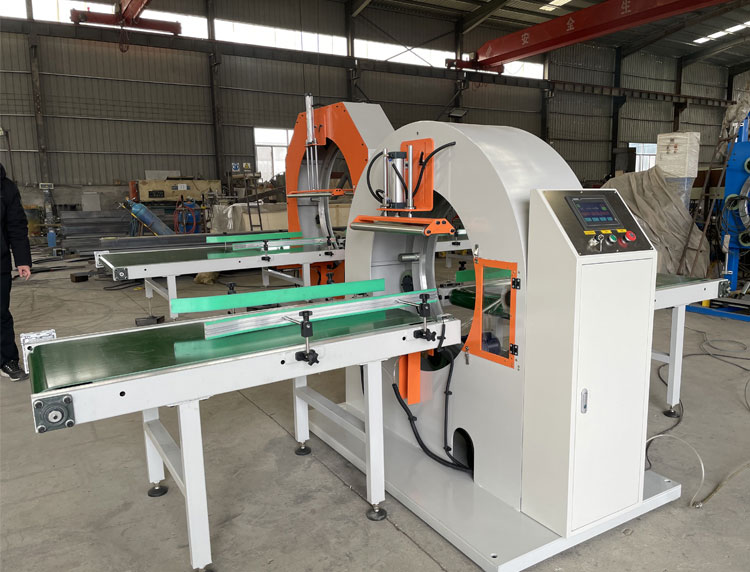
As a result, more and more building material and profile manufacturers are introducing horizontal wrapping machine equipment to improve transportation protection through continuous ring-type wrapping technology.
Why Manual Packaging Still Leads to Wear and Damage on Long Products
In the past, many factories packaged pipes and profiles using manual film wrapping or manual bagging. However, as product dimensions continue to increase and shipment volumes grow larger, the limitations of manual packaging are becoming increasingly obvious.
The first issue is inconsistent packaging tension. During manual wrapping, it is difficult to maintain uniform film tightness along the entire product length. In many cases, the middle section is tightly wrapped while the ends remain insufficiently protected. During long-distance transportation, the tail sections are especially vulnerable to collisions, film loosening, and edge wear.
Secondly, long products themselves are more prone to friction. Steel pipes, aluminum profiles, and sheet materials can easily come into direct contact with each other during forklift handling and vehicle vibration if the outer protection is not secure enough. This often results in surface scratches and negatively impacts the overall product appearance.
Horizontal wrapping machine equipment uses a high-speed rotating ring system that evenly applies stretch film, composite paper, or woven wrapping materials around the product surface, creating a more stable protective structure. For long products today, the key concern is no longer simply “whether the product is packaged,” but whether the product surface can remain intact after transportation.
Why the Building Materials and Steel Pipe Industries Are Paying More Attention to Automated Packaging
Currently, industries increasingly adopting horizontal wrapping machine equipment mainly include steel pipes, aluminum profiles, PVC profiles, sheet materials, and construction materials. These industries share several common characteristics: long product dimensions, large shipment volumes, and growing demands for packaging continuity.
Many large building material manufacturers have already achieved continuous automated production lines. If the packaging section still relies heavily on manual operations, it becomes difficult to maintain production efficiency and synchronize the overall workflow.
For example, galvanized pipes and stainless steel products require high-quality surface finishes. If packaging is delayed, friction damage may already occur during conveyor transportation. Aluminum profiles and coated profiles are even more sensitive to corner impacts and surface scratches during shipment.
Therefore, more factories are introducing horizontal ring wrapping machines integrated with automatic conveyor systems to improve packaging efficiency and transportation stability.
Why More Factories Are Reducing Manual Packaging for Long Products
In the past, many companies considered packaging only as a supporting process and relied mainly on manual labor. However, with increasing labor costs and shipment pressures, traditional manual packaging methods are becoming less capable of meeting large-scale production demands.
Long products are difficult to handle manually. Manual wrapping not only increases labor intensity but also results in inconsistent packaging quality. Many companies only realize the true cost of transportation damage after facing product rework, repainting expenses, and customer complaints, which often exceed the investment cost of packaging equipment itself.
Horizontal wrapping machine models such as the SP1000 can be integrated with roller conveyors, belt conveyors, and other automated systems to achieve automatic product conveying, automatic wrapping, and automatic film cutting. These systems are more suitable for today’s unmanned packaging workshops and automated production environments.
For many building material and profile manufacturers, packaging today is no longer simply about “wrapping the product,” but about minimizing transportation damage, improving shipment quality, and increasing customer acceptance rates.
Why Horizontal Wrapping Machines Are Becoming Essential Equipment for Long Product Packaging
As competition in the building materials and profile industries continues to intensify, more companies are realizing the importance of packaging in overall product value. For steel pipes, aluminum profiles, and sheet materials, the product appearance upon arrival directly affects the customer’s first impression of quality.
Especially in export shipping and long-distance logistics scenarios, products must go through repeated loading, unloading, and warehouse stacking. Without sufficient packaging protection, large-scale abrasion and damage can easily occur.
Therefore, more factories are now adopting horizontal wrapping machine equipment to improve overall product protection through automated continuous packaging while reducing transportation damage and rework costs.