

Why Are Nonwoven Fabric Rolls Most Vulnerable to Edge Damage During Transportation?
Today, many nonwoven fabric manufacturers face a common issue during shipment: rolls look smooth and intact after production, but after forklift handling, warehouse stacking, or long-distance transportation, the edges often become compressed, loose, or contaminated. Especially for white nonwoven fabrics, medical nonwoven materials, and high-GSM rolls, appearance integrity requirements are much stricter. Once edge deformation occurs, it not only affects customer usage but may also impact the stability of downstream processing.
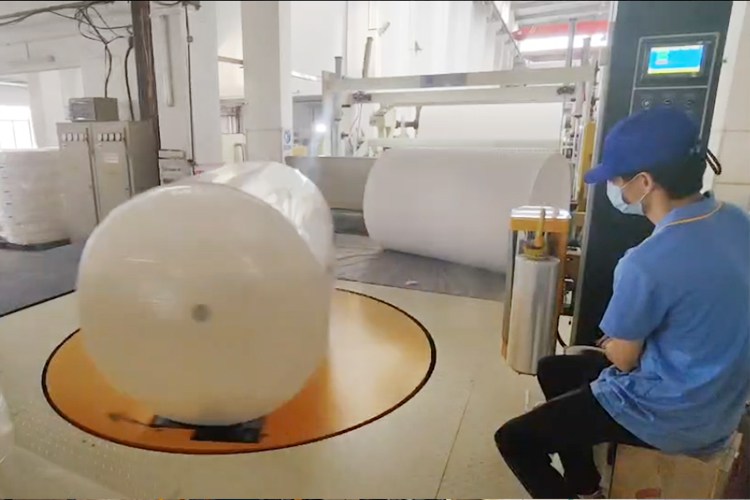
In the past, many factories relied on manual film wrapping or simple outer packaging methods. However, after transportation, edge wear and roll loosening still occurred frequently. Unlike ordinary pallet cargo, roll materials have a cylindrical structure, meaning stress points during transportation are more concentrated. During repeated forklift loading and unloading, both side edges are especially vulnerable to impact damage.
Particularly in export shipping and long-distance logistics, roll products often go through multiple transfers. Without sufficient outer protection, edge deformation and dust or moisture contamination become more likely. As a result, more nonwoven fabric manufacturers are now adopting horizontal stretch film wrapping machines to improve overall roll protection through full horizontal wrapping.
Why Do Rolls Still Become Loose After Manual Film Wrapping?
In the past, many factories tried to reduce packaging costs by using manual wrapping methods to secure rolls. However, as roll sizes continue increasing, the limitations of manual packaging are becoming more obvious.
The first issue is unstable wrapping tension. Different workers apply different force levels during manual wrapping, causing some rolls to be wrapped too loosely while others are over-tightened locally. Especially for large rolls, uneven outer tension can easily lead to loose edges and roll deformation during transportation.
The second problem is incomplete coverage. Manual wrapping often only covers part of the roll, while the areas most vulnerable to damage are usually the edges and bottom sections. For white nonwoven products, even slight contact with dust or oil during transportation becomes highly visible upon delivery.
A horizontal stretch film wrapping machine uses a rotating ring structure to continuously wrap the entire roll, creating a more uniform and stable protective layer. For the nonwoven industry today, the real concern is no longer whether the roll has film protection, but whether the roll can remain intact after transportation.
Why Do Medical Nonwoven Materials and High-End Rolls Require Better Packaging Integrity?
Packaging standards in the nonwoven industry are becoming increasingly strict, especially for medical nonwoven materials, hygiene products, and export-oriented roll products. These materials require much higher cleanliness and edge protection standards.
Many high-end roll products must later be directly mounted onto slitting or continuous unwinding equipment. If roll edges are damaged, issues such as misalignment, material breakage, or unstable processing may occur.
During export transportation, rolls often remain in warehouses and shipping containers for extended periods. Moisture inside containers and constant vibration during shipping continuously affect packaging stability. If the packaging is insufficient, surface wrinkles and deformation can easily appear, potentially affecting customer acceptance.
As a result, more nonwoven manufacturers are investing in horizontal stretch film wrapping machines to improve packaging standardization and transportation protection through automated full-roll wrapping.
Why Are More Roll Manufacturers Upgrading to Automated Packaging?
As shipment volumes continue increasing, traditional manual packaging methods are no longer suitable for continuous production environments. Especially in large nonwoven factories, many production lines already operate at high speed. If the downstream packaging process cannot keep up, the entire production rhythm may be affected.
Horizontal stretch film wrapping machines can integrate with conveyor systems to achieve automatic conveying, automatic wrapping, and continuous packaging, making them more suitable for modern high-volume shipping environments.
For many factories today, packaging is no longer simply about “wrapping the product.” The real focus is how to reduce appearance damage, transportation losses, and rework problems throughout warehousing, shipping, and customer delivery processes.
Therefore, more nonwoven and roll material manufacturers are paying greater attention to automated packaging equipment to improve shipment quality through more stable and standardized packaging methods.