

Why Many Pallets Still Shift During Transportation Even After Being Wrapped
Today, many factories use stretch film to secure palletized cargo, but many companies still encounter one major problem:
The cargo looks stable in the warehouse, but begins shifting once loaded onto trucks.
This is especially common with cartons, beverages, chemical drums, and tall palletized products during forklift transfers or long-distance transportation.
Typical issues include:
Leaning pallets, misaligned cartons, loose wrapping film, cargo shifting, and deformed outer packaging.
Many companies once believed that adding more film layers would solve the problem. However, long-term experience has shown that the issue is not simply the amount of film, but the consistency of film tension and load containment.
If film tension is unstable or wrapping distribution is uneven, even thick wrapping layers may fail during transportation.
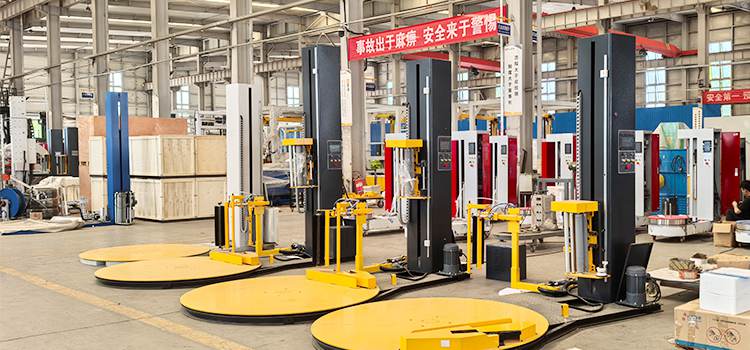
As a result, more factories are upgrading to automatic pallet stretch wrapping machines with pre-stretch film carriage systems and automatic tension control to improve overall packaging stability.
Why Tall Pallets Often Become Loose in the Middle and Lean at the Top
To improve warehouse utilization, many factories stack pallet loads higher than before. However, taller pallets are much more likely to shift during transportation.
This is especially true for:
Beverage cartons, bagged products, chemical raw materials, e-commerce cartons, and appliance packaging.
During forklift braking or turning, the middle layers are often the first to move.
Many customers eventually realize:
The bottom remains tight, while the upper layers begin to sway.
Traditional brake-stretch systems often provide inconsistent film tension, resulting in insufficient wrapping force at the top.
Machines such as the QTP1800F-L fully automatic pallet stretch wrapping machine use pre-stretch film carriage systems to create uniform wrapping force from the bottom to the top of the pallet.
For tall palletized cargo, overall stability improves significantly.
Why More Factories Fear “Transportation Complaints”
In the past, many companies focused primarily on production efficiency. Today, more factories are concerned about how the packaging looks when customers receive the goods.
Because the greatest losses often occur not during manufacturing, but during transportation.
This is especially critical during:
Long-distance logistics, repeated loading and unloading, container transportation, and e-commerce warehouse shipping.
If pallet packaging is unstable, cartons may deform, loads may collapse, and customers may reject shipments.
The food and beverage industry is particularly sensitive because customers now place much higher expectations on packaging appearance.
Even if the products themselves are undamaged, severely deformed packaging can negatively affect customer acceptance.
As a result, more companies are upgrading to fully automatic pallet stretch wrapping machines with automatic film attachment, automatic film cutting, and stable tension control systems to improve packaging consistency.
Why Manual Wrapping Can No Longer Keep Up with Modern Shipping Volumes
In the past, many factories still relied on manual wrapping assistance. However, as shipment volumes continue increasing, the disadvantages of manual packaging are becoming more obvious.
First, packaging consistency varies because every worker wraps differently. Some pallets receive excessive film, while others are wrapped too loosely.
Second, continuous shipment operations become difficult. In automated warehouses and logistics facilities, slow packaging speed can easily create bottlenecks throughout the entire conveyor system.
As a result, many companies are investing in fully automatic pallet stretch wrapping machines equipped with PLC control systems and automatic film clamp/cut devices for continuous operation.
For factories with large shipping volumes, the key issue today is no longer simply whether packaging can be completed, but whether the packaging system can operate continuously and reliably.
Why More Factories Are Upgrading to Fully Automatic Stretch Wrapping Systems
As automated warehouses and unmanned factories continue developing, many companies are redesigning their packaging processes.
Packaging is no longer considered just a supporting process. It is becoming an integrated part of the overall automated logistics system.
For industries such as food, chemicals, building materials, and e-commerce warehousing, packaging efficiency, transportation stability, and continuous operating capability directly affect shipping performance.
That is why more factories are adopting fully automatic pallet stretch wrapping machines with automatic film attachment, automatic film cutting, and conveyor integration to improve overall packaging efficiency and transportation stability.