

Why Moisture Damage Causes Bigger Losses Than Transportation
In the past, many factories focused mainly on whether the side wrapping film was tight enough, while paying little attention to top protection.
However, during rainy seasons or humid southern climates, many companies eventually realize that the most vulnerable part of pallet packaging is actually the top surface.
Once water enters from the top, carton boxes quickly become soft and collapse. Some products appear fine inside the warehouse, but after outdoor loading, temporary storage, or long-distance transportation, moisture damage becomes increasingly serious.
By the time customers receive the goods, cartons may already be deformed, softened, or no longer stackable.
Today, many food manufacturers, beverage companies, e-commerce warehouses, and export businesses are no longer only worried about cargo scattering during transportation. Instead, they are asking:
“Will the packaging still remain intact after delivery?”
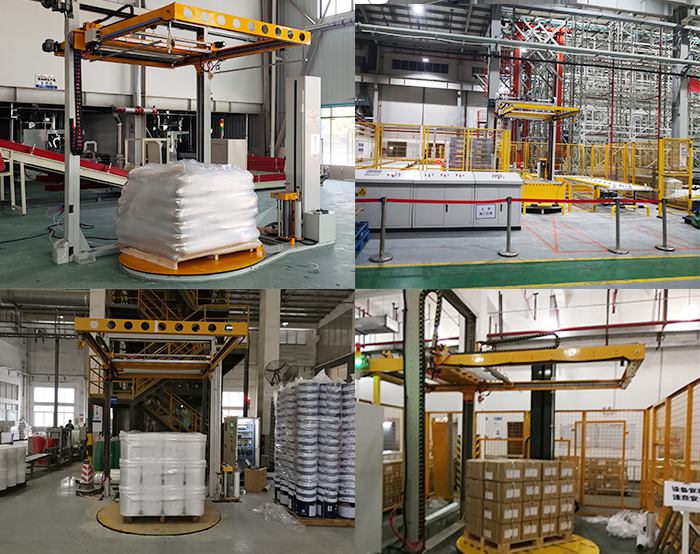
This is why more factories are introducing automatic top sheet wrapping machines to combine top covering and overall pallet wrapping in one process, improving moisture and rain protection during transportation.
Why Top Moisture Damage Is More Serious Than Side Moisture
Many companies once believed that thick side wrapping film alone was enough. But in reality, the pallet top is the area most directly exposed to rainwater and humidity.
This becomes especially problematic during:
- Rainy-day loading
- Outdoor storage
- Port transfer operations
- Container transportation
- Long-distance logistics
Without top protection, rainwater can easily seep into carton gaps. For high-stacked pallets, moisture damage at the top gradually increases pressure on lower cartons, eventually causing full pallet collapse.
Export companies are also paying more attention to top protection because shipping containers often generate condensation during sea transportation. When day-night temperature differences are large, moisture problems become even worse.
Therefore, many companies now add automatic top-cover wrapping not merely for “better-looking packaging,” but to reduce moisture-related transportation losses.
Why Food and Carton Industries Are Paying More Attention to Top Cover Packaging
Industries currently adopting automatic top sheet wrapping machines most actively include:
- Food
- Beverage
- E-commerce warehousing
- Paper manufacturing
- Building materials
These industries share one common characteristic:
They rely heavily on carton packaging.
And cartons are extremely sensitive to moisture.
In food and beverage industries especially, products often require long-term storage and frequent loading operations. Without top protection, outer cartons can quickly become soft and damaged. In retail and supermarket channels, damaged packaging may affect customer acceptance even if the products inside remain intact.
E-commerce warehouses are also shipping goods faster than ever before, with many pallets temporarily waiting outdoors before loading. As a result, top protection has become increasingly important.
After adding automatic top cover pallet wrapping machines, many factories experience significant reductions in:
- Carton collapse
- Moisture-damaged packaging
- Customer rejection
- Blurred labels
- Water accumulation on pallet tops
Why Manual Top Covering Can No Longer Keep Up With Shipping Speed
In the past, many factories manually placed a plastic sheet over the pallet before wrapping it. But as shipping volume increases, manual top covering is becoming increasingly inefficient.
First, manual positioning is unstable. Misaligned film can shift during wrapping. Second, efficiency is slow, especially during peak shipping periods, creating bottlenecks at packaging stations.
For factories with continuous production lines, the real priority today is no longer simply:
“Can the pallet be wrapped?”
Instead, it is:
“Can the packaging process run continuously and consistently?”
Automatic top sheet wrapping machine automatically complete both top covering and overall pallet wrapping, improving packaging consistency while reducing labor involvement. This makes them much more suitable for automated warehousing and conveyor-based shipping systems.
Why More Companies Now Treat Moisture Protection as Essential Packaging
In the past, many factories focused mainly on production efficiency. Today, more companies are paying attention to packaging integrity after transportation.
This is because many companies realize their biggest losses do not happen during production, but after delivery through cargo damage and customer complaints.
For carton-packed products especially, once the top becomes wet, stacking performance and overall brand image can both be affected.
As a result, more manufacturers are upgrading pallet top protection through automatic top sheet wrapping machines. For many large factories, top-cover packaging is gradually changing from an “optional feature” into a “basic packaging requirement.”