

Why Are Palletized Cartons Frequently Damaged in Transit?
At first glance, wrapping cartons onto a pallet seems simple. However, damaged cartons, collapsed loads, moisture penetration, and opened carton lids remain among the most common transportation complaints.
Many people blame weak cartons, poor stacking methods, or rough handling. In reality, the wrapping process often determines whether a shipment arrives safely or becomes a costly claim.
The problem is usually not the carton itself—it is the way the stretch film is applied.
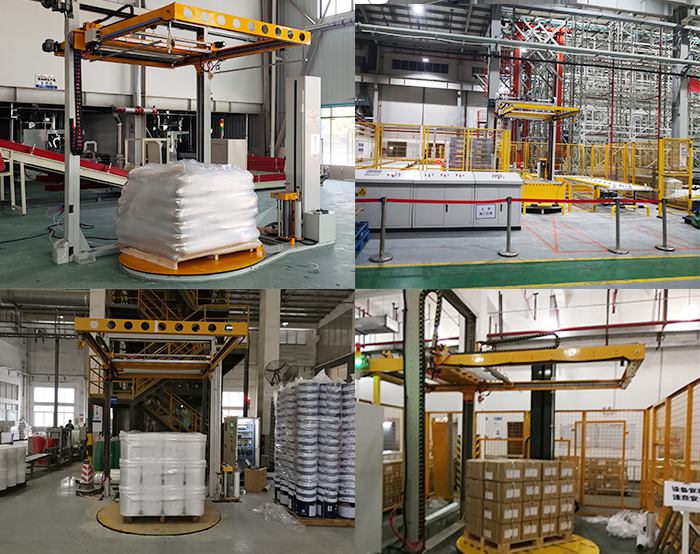
Four Common Causes of Carton Load Failure
1. Load Collapse Caused by Insufficient Bottom Wrapping
Cartons have relatively low friction between layers. During forklift handling or truck transportation, upper cartons can easily shift sideways.
Manual wrapping often focuses too much film on the upper section while neglecting the base of the load.
A pallet stretch wrapper can be programmed to apply additional film wraps at the bottom, securely locking cartons to the pallet before wrapping the entire load, significantly improving load stability.
2. Crushed Cartons Caused by Excessive Film Tension
Many operators believe tighter wrapping means safer transportation.
In reality, excessive film tension can deform carton corners and even damage products inside.
A pre-stretch film carriage solves this problem by stretching the film before application. The film's natural elastic recovery provides holding force without over-compressing the cartons.
The result is a stable load without carton deformation.
3. Open Cartons Caused by Insufficient Top Protection
Many carton loads are stacked with flaps facing upward.
If the top area receives minimal wrapping, transportation vibration can gradually loosen the carton lids, causing products to spill out.
A stretch wrapping machine allows additional top wrapping cycles, helping secure carton lids and reducing the risk of package opening during transport.
4. Moisture Damage Caused by Incomplete Film Coverage
Manual wrapping often creates inconsistent overlap between film layers.
Rain exposure, warehouse humidity, or temperature differences can allow moisture to penetrate gaps in the wrapping.
By precisely controlling film overlap ratios, a stretch wrapper provides complete load coverage and significantly improves protection against moisture and dust.
Why Is a Stretch Wrapping Machine Better Than Manual Wrapping?
Cartons are among the most demanding pallet loads to wrap correctly.
If wrapping is too loose, the load becomes unstable.
If wrapping is too tight, cartons become damaged.
If top coverage is insufficient, cartons may open during transit.
Manual wrapping depends heavily on operator experience and consistency.
A stretch wrapping machine replaces operator judgment with programmable parameters, ensuring every pallet receives the same wrapping quality.
Three Key Advantages
Consistent Film Tension
The pre-stretch carriage uses the film's elastic recovery force rather than excessive pulling force, creating secure load containment without damaging cartons.
Smooth Rotation Control
Variable-frequency soft start and soft stop technology gradually accelerates and decelerates the turntable.
This reduces load shifting and minimizes the risk of unstable pallet loads tipping during wrapping.
Customized Wrapping Programs
PLC control allows independent adjustment of:
- Bottom wrap reinforcement
- Top wrap reinforcement
- Film overlap ratio
- Wrapping cycles
- Up-and-down travel patterns
This enables optimized protection for the most vulnerable parts of carton loads.
Choosing the Right Stretch Wrapper Matters
Many companies invest in a wrapping machine but still experience shipping issues.
The most common reasons are:
Using Brake Stretch Instead of Pre-Stretch
Brake stretch systems rely on film resistance to create tension and can apply uneven force to cartons.
Pre-stretch film carriages are generally the preferred solution for carton loads because they provide more uniform load containment.
Incorrect Machine Settings
Insufficient bottom wraps, inadequate top coverage, or low film overlap settings can reduce wrapping effectiveness.
Proper parameter setup typically takes only a short time and ensures consistent results for every pallet afterward.
Factory Direct Supply with Customization Available
The FTP1800F-L Top Sheet Pallet Stretch Wrapper is designed for a wide range of palletized carton applications.
Key specifications include:
- Wrapping height: 500–2000 mm
- Turntable capacity: 2000 kg
- Packaging speed: 10–20 pallets/hour
- Machine weight: 900 kg
- Optional top-sheet covering system
- Optional weighing system
- Optional larger turntable sizes
- Optional loading ramp
As a professional stretch wrapping machine manufacturer, we complete welding, assembly, testing, and commissioning in-house. Each machine is configured according to customer load requirements before shipment, helping customers achieve reliable packaging performance from day one.