

The Stretch Film Wrapping Machine is the most widely used model in the wrapping machine industry.
Simply place a palletized load on the turntable, press the start button, and the machine automatically wraps the load. While it may not be a fully automated packaging line, it is often the first step factories take when transitioning from manual wrapping to automated packaging.
Who Needs a Stretch Film Wrapping Machine?
If workers in your facility are still manually wrapping pallets, the following situations may sound familiar:
Operators walk around pallets repeatedly with rolls of stretch film. Wrapping a single pallet can take three to five minutes, resulting in physical strain and inconsistent packaging quality. Some loads are wrapped tightly, while others are not secure enough. Film consumption is often excessive because workers apply additional layers to ensure stability.
A stretch film wrapping machine marks the transition from manual wrapping to machine-assisted packaging. No production line modifications are required. Operators simply place the pallet on the turntable and start the machine.
Three Key Factors to Consider When Choosing a Wrapping Machine
Although many wrapping machine models are available, three factors determine overall performance:
1. Film Savings
The most important component is the pre-stretch film carriage. The TP Series is equipped with a powered pre-stretch system that elongates the film before application. This significantly increases film coverage and can reduce film consumption by approximately 50% compared with manual wrapping.
The result is tighter load containment with lower packaging costs.
2. Wrapping Stability
The turntable speed is controlled by a variable-frequency drive and adjustable from 0–12 rpm. Soft-start and soft-stop functions prevent sudden acceleration and deceleration, reducing the risk of load instability.
Heavy pallets can be wrapped at lower speeds, while lighter loads can be processed more quickly, ensuring reliable packaging performance across different applications.
3. Ease of Installation and Operation
The TP Series operates on a standard 220V power supply with a total power consumption of only 1.5 kW, eliminating the need for dedicated industrial power infrastructure.
The turntable supports loads up to 2000 kg and features a diameter of 1650 mm with a low-profile height of only 85 mm, allowing easy forklift loading and unloading. The machine weighs approximately 550 kg and requires minimal installation space.
Optional Upgrades for Specialized Requirements
While the standard model meets the needs of most facilities, several optional features are available:
Loading Ramp
Ideal for facilities without forklifts or where manual pallet handling is required.
Larger Turntable
Suitable for oversized loads that exceed standard pallet dimensions.
Integrated Weighing System
Allows weighing and wrapping operations to be completed simultaneously.
Slewing Bearing Turntable
Provides enhanced durability, load capacity, and rotational accuracy for demanding applications.
Calculating the Return on Investment
The investment in a stretch film wrapping machine is relatively modest, while the savings are substantial.
Reduce Film Costs
The pre-stretch carriage can reduce film consumption by approximately 50%, often generating enough savings to offset equipment costs within months.
Reduce Labor Costs
One machine can replace the workload of one or two manual wrapping operators, allowing employees to focus on higher-value tasks.
Reduce Transportation Damage
Consistent packaging quality improves load stability and reduces product damage, rejected shipments, and customer complaints.
For factories still relying on manual wrapping, the question is often not whether to purchase a wrapping machine, but how soon the investment can begin generating savings.
Manufacturer Direct Supply with Customization Available
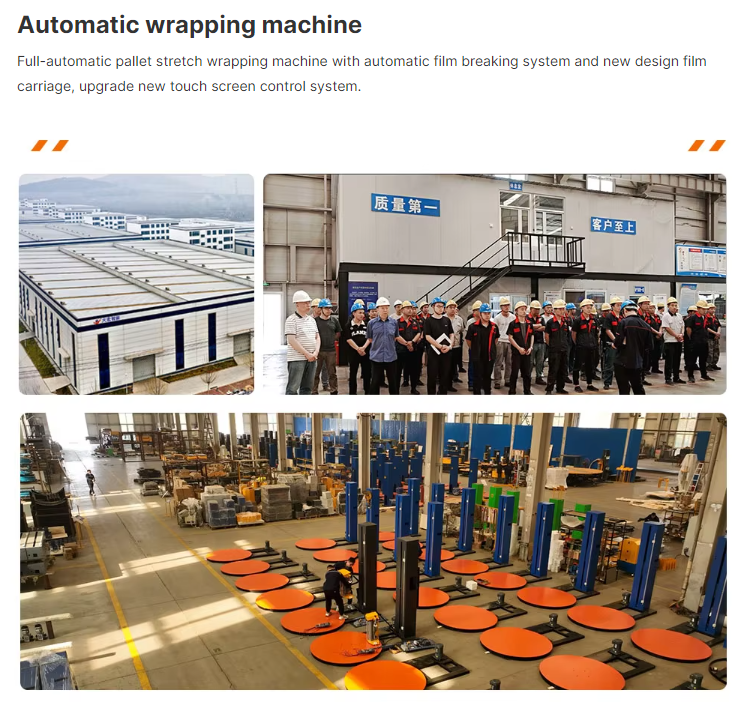
As a professional wrapping machine manufacturer, every TP Series machine is produced entirely in-house, from fabrication and assembly to testing and final inspection.
Turntable size, wrapping height, film carriage configuration, and conveyor integration options can all be customized according to customer requirements, ensuring reliable performance from the moment the machine is installed.