

Why Packaging is Becoming Increasingly Important for Paper Roll Products
For Paper Roll Stretch Wrapping Machines, production completion does not guarantee successful delivery.
The quality of packaging often determines whether products arrive at customer facilities in perfect condition.
Paper rolls such as kraft paper, coated paper, cardboard, industrial packaging paper, and specialty paper are frequently exposed to multiple handling processes, including forklift transportation, warehousing, and logistics operations.
Without adequate protection, roll edge damage, surface scratches, and moisture contamination can occur.
As a result, more paper mills are incorporating packaging quality into their overall quality management systems.
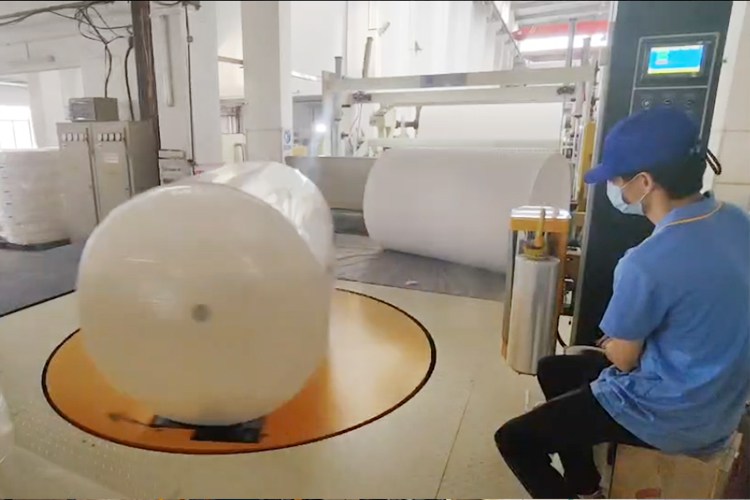
Why Edge Protection is Critical for Paper Roll wrapping machine
Unlike standard palletized products, paper rolls have a cylindrical structure that concentrates impact forces on the roll edges.
Whether during warehouse handling or transportation, roll edges are often the first areas to suffer damage.
For export shipments and long-distance transportation, rolls may be transferred multiple times before reaching customers.
Even minor edge damage can affect unwinding, slitting, printing, and other downstream processes.
Therefore, many manufacturers are adopting paper roll stretch wrapping machines to provide continuous 360-degree protection around the entire roll surface.
Automation is Transforming Traditional Roll Packaging Methods
Historically, many paper mills relied on manual wrapping or semi-automatic packaging equipment.
However, as production volumes increase, traditional packaging methods struggle to meet modern manufacturing requirements.
Manual operations often create inconsistent packaging quality, while limited packaging speed can slow down shipment schedules.
Equipment such as the HYP2000F-AU Rotary Ring Wrapping Machine is designed for paper rolls, nonwoven rolls, tire cord fabric, coils, and rubber products. It provides complete 360-degree wrapping protection and supports roll diameters ranging from 600 mm to 1500 mm.
With packaging capacities of 10–30 rolls per hour, it satisfies the continuous packaging requirements of most roll-product manufacturers.
Why More Paper Mills are Focusing on Packaging and Logistics Costs
As competition in the paper industry intensifies, manufacturers are looking beyond production costs to identify opportunities for reducing logistics expenses.
Transportation damage often remains a hidden cost until problems occur.
A paper roll may pass through warehousing, loading, transportation, transfer stations, and unloading before reaching the customer.
Any collision or moisture exposure along the way can compromise product quality.
For high-value paper products, transportation damage can lead to substantial financial losses and negatively impact long-term customer relationships.
Consequently, more companies are investing in standardized packaging systems to improve consistency and reduce transportation risks.
Paper Roll Stretch Wrapping Machines are Becoming Essential Equipment for the Roll Material Industry
As paper, nonwoven fabric, and industrial roll material industries continue to expand, packaging equipment has evolved from a simple auxiliary tool into a critical component of product protection and logistics management.
The value of packaging extends beyond dust and moisture protection. It ensures that products arrive at customer sites in optimal condition.
For this reason, paper roll stretch wrapping machines are increasingly adopted by roll-product manufacturers to improve transportation protection, reduce edge damage, enhance delivery quality, and support long-term customer satisfaction.