

Pain Points and Improvement Needs in Long-Product Packaging
In industries such as aluminum profiles, wooden strips, plastic profiles, and pipes, packaging quality directly influences transportation performance and customer acceptance. Manual film wrapping or improper use of vertical wrapping equipment often results in uneven film tension, insufficient end wrapping, or surface scratches—issues that become more severe during long-distance transportation or repeated loading and unloading. As a result, more enterprises are shifting toward horizontal wrapping equipment tailored for long materials to achieve consistent wrapping and reduce damage through mechanical and parameter-controlled operations.
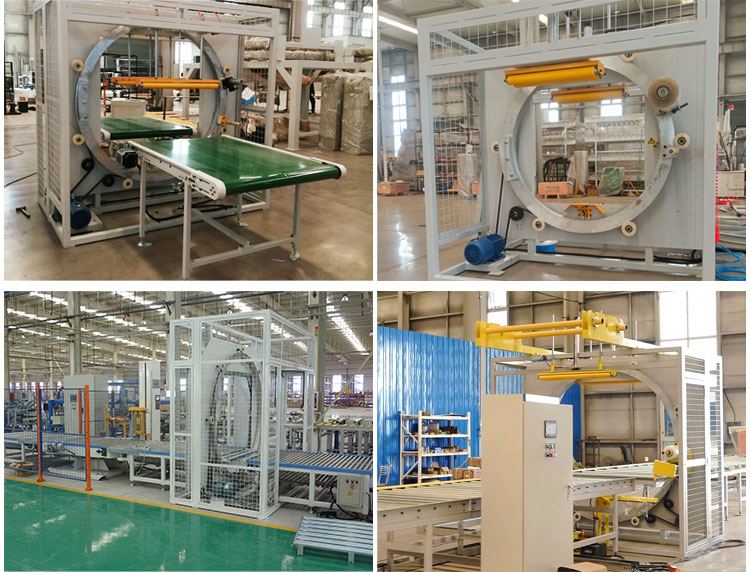
Working Principle: Coordination Between Ring Rotation and Material Feeding
Profile horizontal wrapping equipment enables materials to move linearly while the rotating ring performs spiral wrapping, achieving 360° continuous coverage without altering the product’s orientation. The system typically consists of a conveyor unit, ring-type wrapper, pre-stretch film carriage, PLC control unit, and photoelectric sensors. The conveying system ensures smooth feeding, the ring performs wrapping at the preset speed and overlap rate, and the pre-stretch mechanism applies stable tension before film reaches the product surface—enhancing adhesion while reducing film consumption. All actions are program-controlled to ensure repeatability.
Adjustable Parameters for Various Materials and Specifications
To match different materials, hardness, thicknesses, and lengths, pipe wrapping equipment offers adjustable parameters including ring speed, conveyor speed, pre-stretch ratio, overlap rate, and end-reinforcement cycles. For surface-sensitive or coated panels, tension can be reduced and overlap increased to avoid indentation. For long-distance transport or multi-stacking scenarios, additional reinforcement layers and higher stretch ratios can be applied to enhance tightness and stability.
Conveying & Operation: Improving Workshop Rhythm and Reducing Labor Intensity
When connected with roller or belt conveyors, horizontal wrapping machines can achieve automated feeding, positioning, wrapping, and discharging. This reduces manual handling frequency, minimizes human-induced inconsistencies, and optimizes on-site logistics. Clear operation interfaces and basic fault-alert functions enable new operators to adapt quickly, supporting reliable multi-shift production.
Industry Application: Typical Improvements in Construction Materials and Metal Products
For example, an aluminum profile manufacturer producing 3–6 meter window frame profiles frequently experienced loose ends and surface scratches with manual wrapping. After adopting horizontal wrapping equipment and optimizing film tension and reinforcement cycles, the company reported improved surface integrity and enhanced end protection during transport. Continuous packaging also synchronized better with upstream processes, increasing shipping efficiency and reducing rework costs.
Driving Mechanized and Standardized Packaging for Long Materials
Horizontal stretch film wrapping machine equipment provides a systematic solution for protecting long materials during storage and transportation through ring wrapping, adjustable parameters, and continuous conveying. For companies seeking consistent packaging quality, lower damage rates, and improved workflow efficiency, this equipment offers both performance enhancement and a scalable foundation for automation upgrades.