

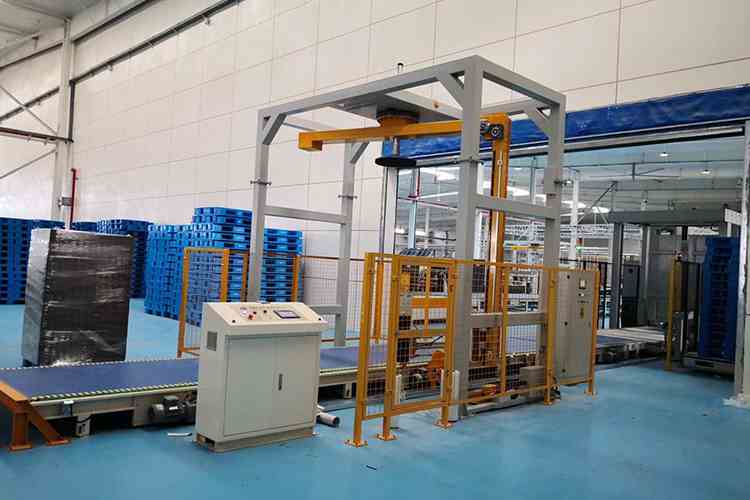
A rotary arm stretch wrapper is an automated pallet wrapping system in which a horizontal arm rotates around a stationary pallet, applying stretch film to secure the load. Unlike turntable machines that spin the pallet, the load remains completely still during wrapping, making it the preferred choice for fragile, heavy, or tall/lightweight products.
In this comprehensive guide, we'll cover everything you need to know before investing in a rotary arm stretch wrapper: how it works, when it's the right choice, key technical specifications to compare, typical pricing ranges, and how to select the right model for your operation.
How Does a Rotary Arm Stretch Wrapper Work?
Understanding the mechanics of a rotary arm wrapper helps you evaluate whether it fits your facility and product requirements. Here's the step-by-step process:
Pallet positioning: A loaded pallet is moved into the wrapping zone — either by forklift or conveyor — and centered under the rotary arm
Film thread: Stretch film is loaded onto the film carriage mounted on the rotating arm, with the film end secured to the pallet or held by a clamp system
Arm rotation: The arm begins rotating around the stationary pallet at a controlled speed (typically 8–15 rpm for industrial models)
Film carriage ascent/descent: The film carriage moves up and down the mast in synchronization with the arm rotation, creating the desired wrap pattern
Pre-stretch application: As film is dispensed, a pre-stretch mechanism stretches it 200–300% before application, dramatically reducing film consumption per pallet
Wrap completion: Once the programmed number of wraps and top/bottom reinforcement cycles are complete, the film is cut and clamped
Pallet exit: The finished pallet exits the wrapping zone, ready for shipping or storage
The key distinguishing feature is that the load never moves. This single design difference opens up a wide range of applications where turntable wrappers would struggle or fail entirely.
Key Advantages of Rotary Arm Stretch Wrappers
Why would you choose a rotary arm machine over a turntable wrapper or other wrapping technologies? Here are the most compelling benefits:
1. Handles Unstable or Top-Heavy Loads
The biggest advantage is also the most obvious: no pallet rotation means no centrifugal force pushing your product outward. This is critical for:
Tall, narrow loads that could topple on a turntable
Lightweight products (empty containers, foam, insulation) that shift easily
Fragile goods (glass, electronics, ceramics) that can't tolerate rotation stress
Unstable pallet patterns (mixed SKUs, irregular shapes)
2. Higher Throughput Capacity
Because the pallet doesn't need to accelerate and decelerate — which takes significant time, especially with heavy loads — rotary arm machines can achieve faster cycle times. High-speed models can wrap up to 40–60 pallets per hour, compared to 20–35 pallets/hour for typical turntable automatics.
3. Superior for Very Heavy Loads
Turntable wrappers are typically rated for 2,000–4,000 kg maximum, and the heaviest models top out around 5,000 kg. Rotary arm wrappers have essentially unlimited weight capacity since the load never moves. They're commonly used for loads weighing 5,000–10,000 kg+, such as machinery, steel coils, and industrial equipment.
4. Better Load Containment Consistency
With the load stationary and the arm rotating at a controlled speed, film tension remains more consistent throughout the wrap cycle. This results in:
More uniform containment force across the entire pallet
Fewer film breaks caused by load shifting
Better protection against load shifting during transit
More predictable wrapping quality from pallet to pallet
5. Easier Integration with Conveyor Lines
Rotary arm wrappers integrate seamlessly with automated conveyor systems because the pallet simply moves straight through the wrapping zone — no turntable alignment or lift required. This makes them the standard choice for fully automated end-of-line packaging systems.
When to Choose a Rotary Arm Stretch Wrapper (vs. Alternatives)
A rotary arm wrapping machine is a significant investment — typically 50–150% more expensive than a comparable turntable machine. So how do you know if it's worth the premium?
|
Scenario |
Rotary Arm Wrapper |
Turntable Wrapper |
|
Load weight > 2,000 kg |
choice |
May exceed capacity |
|
Load weight > 4,000 kg |
Only practical option |
Not suitable |
|
Unstable / top-heavy loads |
Excellent |
Risk of tipping |
|
Fragile / delicate products |
Gentle, no rotation |
Acceptable for sturdy goods |
|
High throughput (30+ pallets/hr) |
Higher capacity |
May need two machines |
|
Automated conveyor integration |
Seamless |
Possible but complex |
|
Small space / low ceiling |
Requires headroom |
More compact |
|
Budget-conscious operation |
Higher initial cost |
More affordable |
|
Light / standard pallet loads |
Overkill |
Perfect fit |
Rule of thumb: If you can wrap your product successfully on a turntable machine, a turntable wrapper is usually the more cost-effective choice. Choose rotary arm when you have specific constraints — weight, stability, throughput, or automation integration — that turntable machines can't meet.
Top Industries and Applications for Rotary Arm Wrappers
Rotary arm stretch wrapping machines find their sweet spot in industries with heavy, fragile, or high-volume palletization requirements. Here are the leading applications:
1. Building Materials & Construction
Products: Cement bags, bricks, tiles, insulation panels, gypsum board, steel bars, piping
Why rotary arm? Building materials are often heavy, bulky, and unstable on pallets. A pallet of 50 cement bags can weigh 2,000–2,500 kg, and a single misaligned bag on a turntable could cause a catastrophic load shift. Rotary arm wrappers keep everything locked in place.
Recommended approach: Heavy-duty rotary arm models with reinforced masts and high-torque drives, paired with 23–30 micron high-performance stretch film for maximum containment.
2. Chemical & Petrochemical
Products: Chemical drums, IBC totes, bagged chemicals, industrial adhesives, paint buckets
Why rotary arm? Chemical products are often heavy and hazardous, with zero tolerance for spills or load failure. The stationary-load design eliminates the risk of drum rupture or seal failure from rotation forces.
Recommended approach: Stainless-steel or corrosion-resistant models for harsh environments, with explosion-proof options available for flammable product zones.
3. Food & Beverage (High-Volume)
Products: Cases of bottled water, canned goods, beverage cartons, bagged grain, frozen foods
Why rotary arm? While many food and beverage operations use turntable wrappers, high-volume production lines (50+ pallets/day) benefit from the faster cycle times and conveyor integration of rotary arm systems.
Recommended approach: Stainless steel construction for wash-down environments, food-grade lubricants, and hygienic design compliance.
4. Automotive & Parts Manufacturing
Products: Engine components, stamped metal parts, tires, interior trim panels, assembled modules
Why rotary arm? Automotive parts come in irregular shapes and varying weights that can make pallet loads unstable. The consistent wrap quality of rotary arm machines ensures parts arrive at assembly plants undamaged.
Recommended approach: Automated inline systems with pallet identification and recipe selection, integrated with existing production line controls.
5. Paper & Pulp Industry
Products: Paper rolls, cardboard sheets, packaging board, tissue products
Why rotary arm? Paper rolls are both heavy and easily damaged by improper handling. Standing a paper roll on a turntable and spinning it can cause deformation or "egging" at the base. Wrapping them stationary preserves product integrity.
Recommended approach: Specialized rotary arm wrappers with roll-handling attachments and variable tension control to prevent film crushing of soft paper products.
6. Logistics & Distribution Centers
Products: Mixed-SKU pallets, retail distribution loads, e-commerce fulfillment pallets
Why rotary arm? Distribution centers deal with mixed, unpredictable pallet loads every day. What's stable one pallet might be precarious the next. Rotary arm wrappers handle this variability without operator intervention.
Recommended approach: High-speed models with quick-change film systems, integrated scale options, and warehouse management system (WMS) connectivity.