

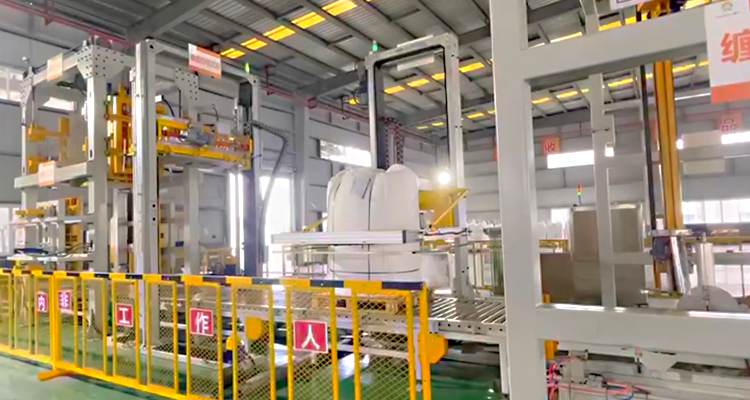
Why pallet packaging is shifting from standalone machines to integrated line systems
With the continuous expansion of production scale, traditional standalone packaging machines can no longer meet continuous shipping demands. In the past, companies typically relied on manual forklift handling, single-machine wrapping, and manual strapping, which resulted in low efficiency and unstable process connections.
Especially in food & beverage, chemical raw materials, and e-commerce warehousing industries, order cycles are becoming faster and shipment volumes larger. Any bottleneck in the packaging process directly affects overall delivery efficiency. As a result, more companies are integrating wrapping and strapping equipment into continuous packaging line systems.
Why “wrapping + strapping” combinations are becoming more common
In actual transportation, palletized goods face two major risks:
- Load instability causing shifting
- Insufficient surface protection leading to moisture or contamination
Stretch wrapping machines mainly provide overall containment by forming an external protective layer with stretch film, improving dustproof and moisture-proof performance. Strapping machines, on the other hand, use PP or PET straps to reinforce the structure and prevent lateral movement during transportation.
When combined, they solve both external protection and internal reinforcement problems, making pallet loads more stable during long-distance transport, forklift handling, and warehouse stacking.
How line systems improve shipping efficiency
A strapping + wrapping line typically uses a conveyor system to transport pallets through different workstations, completing automatic strapping, automatic wrapping, and automatic output processes. The entire workflow requires no manual intervention, significantly reducing intermediate handling.
For example, when a through-type strapping machine is combined with a pallet wrapping machine, the system enables automatic strap feeding, tightening, and synchronized wrapping control, resulting in a more consistent packaging cycle. For high-volume businesses, this continuous system significantly improves logistics efficiency.
At the same time, line-based systems standardize packaging quality, ensuring consistency across batches and improving overall delivery reliability.
Industries suitable for strapping + wrapping integrated lines
This solution is especially suitable for industries requiring high transport stability, such as:
- Food & beverage (prevent pallet collapse)
- Chemical industry (prevent bag shifting)
- Automotive parts (protect high-value components)
- Building materials, electronics, and cross-border logistics
As pallet standardization increases, this integrated packaging system is becoming a mainstream solution.
Automation is driving logistics system upgrades
With the rise of smart factories and automated warehousing, packaging is evolving from single machines into system-level solutions. The strapping + wrapping line is not just equipment integration, but a key part of automated logistics systems.
By integrating with palletizing systems, conveyor systems, and warehouse management systems, it enables end-to-end automation from production to outbound shipping. This reduces labor costs while improving operational stability and controllability.
A key configuration for modern factories
As requirements for efficiency, transport safety, and standardized packaging continue to increase, single machines are no longer sufficient for complex logistics needs.
The strapping + wrapping line system provides dual protection through “strapping reinforcement + stretch film wrapping,” and is widely used in food, beverage, chemical, automotive, building materials, and logistics industries, becoming an essential configuration for modern factories.
FAQ
Q1: What is the difference between integrated line systems and standalone machines?
Standalone machines perform a single function, while line systems enable continuous automatic conveying, strapping, and wrapping, improving efficiency.
Q2: Why use both wrapping and strapping?
Wrapping provides surface protection, while strapping provides structural reinforcement. Together they improve both stability and protection.
Q3: Which industries are suitable?
Food, beverage, chemical, building materials, automotive parts, electronics, and logistics.
Q4: Can it operate fully automatically?
Yes, it can be integrated with conveyors and palletizing systems for unmanned operation.
Q5: Is maintenance complicated?
No, modular design makes maintenance simple, mainly focused on key wrapping and strapping components.