

Transformation from Multi-Process to Integrated Packaging
In traditional pallet packaging, wrapping and strapping are often handled as two separate processes. This requires manual transfer between machines, which reduces efficiency and may lead to inconsistent packaging quality.
With increasing demand for automation and process integration, integrated wrapping and strapping machines are widely adopted to streamline operations, reduce intermediate steps, and improve overall productivity.
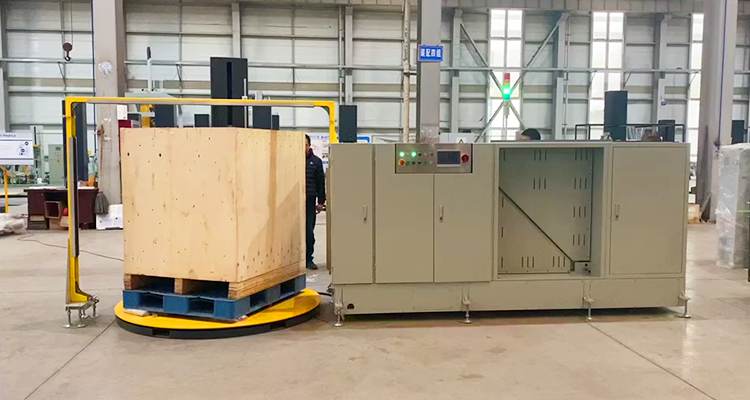
Modular Combination of Wrapping and Strapping Functions
The integrated machine typically consists of a wrapping unit and a strapping unit, combined with a conveyor system to form a continuous packaging line.
The pallet is first wrapped with stretch film and then transferred to the strapping section for reinforcement. The entire process is coordinated through a centralized control system.
Continuous Operation Through Automatic Synchronization
During operation, pallets are conveyed into the wrapping station where the system automatically detects load height and performs wrapping.
After wrapping, the pallet moves to the strapping unit for horizontal or vertical strapping. The whole process runs automatically without manual intervention, ensuring consistent cycle time and improved efficiency.
PLC Control Ensures Stable Multi-Process Coordination
The machine is usually equipped with a PLC control system, allowing parameter settings such as wrapping layers, strapping times, and positions.
Features like automatic film cutting, film attachment, and strapping control ensure stable continuous operation. The system can also be integrated with conveyors and palletizers to form a complete automated packaging line.
Improved Packaging Strength and Stability
The combination of wrapping and strapping provides dual protection. Wrapping stabilizes the load, while strapping reinforces structural integrity, reducing the risk of shifting during transportation.
Wide Application Across Industries
This equipment is widely used in industries such as chemicals, building materials, food & beverage, and e-commerce warehousing. It enhances load stability and improves packaging efficiency in various scenarios.