

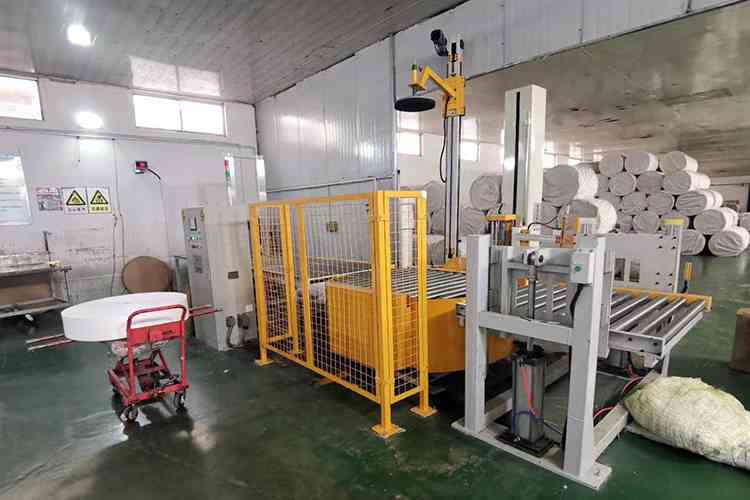
Equipment Positioning for Continuous Packaging Scenarios
Full automatic inline stretch wrapping machines are typically installed at the end of production lines or outbound conveyor systems. By connecting with roller conveyors or chain conveyors, pallets are automatically conveyed into and out of the wrapping station. Once a pallet reaches the correct position, the machine automatically completes positioning, wrapping, and release without manual intervention. This inline structure integrates the wrapping process into the overall packaging flow rather than treating it as a separate operation.
Impact of Inline Wrapping Structure on Process Continuity
During operation, the inline stretch wrapping machine completes film wrapping using a turntable or ring structure while remaining synchronized with upstream and downstream conveying equipment. After the pallet enters the machine, the system automatically detects pallet height and executes the preset wrapping program. Once wrapping is complete, the pallet is conveyed to the next station. This process reduces manual waiting and transfer steps, helping maintain continuous production flow.
Packaging Consistency Achieved Through Automatic Wrapping
Compared with manual or semi-automatic wrapping, full automatic inline stretch wrapping machines use program-controlled parameters for wrapping cycles, film carriage speed, and pre-stretch ratios. This ensures consistent packaging results for every pallet. For manufacturing enterprises requiring uniform packaging standards, such consistency is valuable for stacking, transportation, and warehouse management, while also minimizing downstream adjustments caused by packaging variations.
Pre-stretch Film Carriage and Film Consumption Control
These machines are usually equipped with pre-stretch film carriages, allowing adjustable stretch ratios to maintain stable film tension during wrapping. This design ensures proper load containment while controlling film usage, preventing material waste caused by unstable wrapping parameters. Under continuous operation, such stability is particularly important for long-term efficiency.
Online Adaptability for Multiple Pallet Specifications
In different production environments, pallet sizes, load heights, and weights vary. Full automatic inline stretch wrapping machines use height detection and parameter settings to accommodate multiple pallet specifications. Operators can select different wrapping programs based on product types, enabling continuous packaging of mixed pallets on the same production line and enhancing overall flexibility.
Typical Industry Applications
In industries such as food and beverage, chemicals, daily consumer goods, building materials, and e-commerce warehousing, full automatic inline stretch wrapping machines are widely used in bulk finished goods outbound or fully automated packaging systems. After wrapping, pallets can directly enter palletizing, top-sheet covering, or automated storage processes, forming a more complete automated packaging workflow.
From an overall packaging perspective, full automatic inline stretch wrapping machines improve continuity and stability by integrating with conveyor systems. For enterprises with fast shipping rhythms and continuous packaging needs, this equipment offers practical value in standardizing packaging processes and reducing manual intervention. Proper configuration based on line speed and pallet specifications contributes to long-term operational stability.