

Manual Wrapping Causes Inconsistent Packaging Quality Across Pallets
In production environments such as food and beverage, household appliances, chemical raw materials, and warehousing logistics, palletized transportation is the most common outbound method. However, many companies still rely on manual wrapping. This not only results in high labor intensity, but also causes variations in film tightness, finishing quality, and reinforcement layers due to differences in operator experience.
When shipping frequency increases, these inconsistencies become even more evident, potentially affecting pallet stability during handling and transportation.
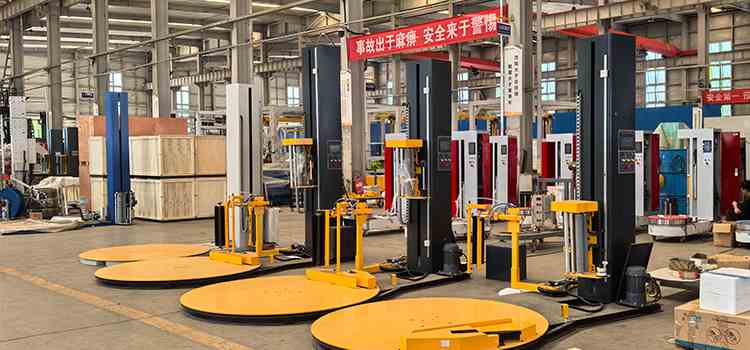
The automatic film-clamping and cutting pallet wrapping machine addresses these issues by automating film attaching, film cutting, film smoothing, and programmed wrapping. It transforms the pallet wrapping process from “experience-based” to “controlled operation”, allowing companies to maintain neat and consistent wrapping quality even during peak shipping periods.
Structural Design: Automatic Film Clamping & Stable Film Attaching Improve Packaging Continuity
The core structures of the automatic film-clamping and cutting pallet wrapping machine include:
Automatic film-clamping mechanism
Automatic film-cutting device
Pre-stretch film carriage
Dual-chain mast lifting system
PLC control unit
Once the pallet enters the wrapping station, the film-clamping mechanism automatically grips the film edge and attaches it to the pallet surface, reducing manual intervention and enabling a faster start to the wrapping cycle.
The pre-stretch film carriage uses gears or electric ratio control to stretch the film to a preset ratio, ensuring better film tension and reducing material usage.
The mast uses a dual-chain lifting structure to maintain stable film-carriage movement and accommodate various pallet heights. Both the lifting speed and turntable speed can be adjusted via frequency converters, ensuring smoother wrapping during start, acceleration, and deceleration, and preventing load sway.
At the end of the cycle, the automatic film-cutting and smoothing mechanism cuts the film and presses the tail neatly onto the pallet surface, ensuring a clean and uniform finish for every load.
Packaging Features: Fully Automated from Reinforcement to Film Tail Finishing
The pallet wrapping machine delivers a complete automated packaging workflow. It can be programmed for bottom reinforcement, top reinforcement, full spiral wrapping, and multi-section strengthening based on pallet weight and stacking configuration.
With the film stretched in a pre-stretched state, the tension is more uniform, reducing the risk of loose wrapping or film breakage from excessive force.
In fast-paced production environments, the automatic cutting system minimizes downtime at each pallet’s finishing stage, enabling continuous operation. The film tail is automatically smoothed onto the load surface, improving transport durability and preventing loosening caused by outward-facing film tails.
In high-frequency packaging operations, this automated process significantly reduces repetitive manual tasks, making the workflow more streamlined and efficient.
Wide Industry Applicability and Compatibility with Various Pallet Specifications
The automatic film-clamping and cutting pallet wrapper is suitable for diverse palletized outbound applications:
Food & beverage: enhances stability for bottled, canned, and barreled products, while improving appearance consistency
Home appliances & furniture: protects cartons from dust, moisture, and external impacts
Chemical industry: ensures stable transportation of bagged powders and liquid drums by adjusting reinforcement layers
E-commerce logistics and warehousing: emphasizes speed and efficiency, reducing repetitive manual labor
Automated Pallet Packaging: A Key Step Toward Stable and Efficient Outbound Logistics
With its high degree of automation and stable wrapping workflow, the automatic film-clamping and cutting pallet wrapping machine provides a reliable and consistent packaging solution for manufacturers.
As industries continue to raise requirements for load stability, appearance uniformity, and outbound efficiency, fully automatic wrapping machines are becoming essential for upgrading warehouse packaging processes. Replacing repetitive manual tasks with automation is a critical step toward standardized and efficient palletized packaging.