

Checked luggage is vulnerable during handling — luggage packing machines offer travelers added protection
With rising air, rail and cross-border travel, checked baggage faces knocks, abrasion, moisture, and label loss during handling, sorting and transport. Especially during peak periods when baggage throughput is high, softer materials or less-rigid suitcases can crack, wear, or deform after repeated handling. Airport luggage wrapping machines wrap luggage with film to create a full covering that provides more reliable protection, standardizing the packing experience and making the checked baggage process more controllable.
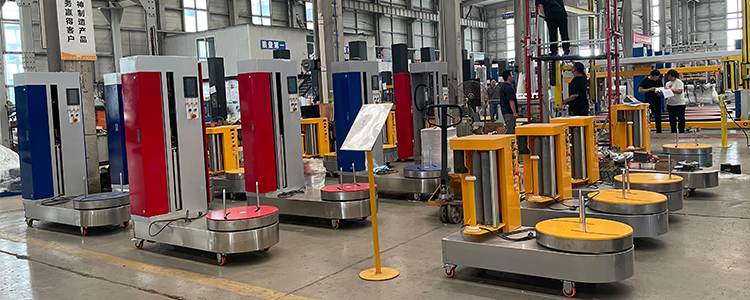
Wrapped film layers improve outer protection and reduce transport damage
Luggage wrapping machine primarily use stretch film to cover the entire suitcase via a turntable that rotates the bag while the film is applied in a spiral. Wrapped luggage surfaces significantly reduce direct friction with conveyor belts, metal frames, and other luggage, providing a protective outer layer. For fabric suitcases, polycarbonate cases, older luggage, or temporary cartons, film wrapping reinforces structural stability so they remain intact during handling, loading and sorting. In rainy or outdoor transfer scenarios, the film also reduces moisture ingress and lowers the risk of deformation caused by dampness.
Turntable rotation boosts wrapping efficiency — suitable for busy airports
Airport luggage wrappers use a turntable drive to achieve continuous wrapping. Operators only need to adjust the column for suitcase height, place the luggage on the turntable, and start the program. Compared with manual wrapping, mechanized wrapping is more consistent and uniform, adapting well to high-frequency luggage packing demands in airport halls. During peak check-in periods, mechanized wrapping shortens handling time per piece and reduces queueing, keeping passenger flows smooth and improving throughput for airports and baggage service providers.
Wrap thickness (number of film layers) is adjustable to match protection needs
Luggage wrappers allow setting different film layer counts so covering thickness can be tuned to suitcase material, transport distance and traveler needs. For example: increase layers for soft suitcases to improve impact resistance; add top and bottom reinforcement wraps for temporary cartons; reduce wraps for small items to speed processing; strengthen film for long-haul international transport. This flexibility makes luggage wrappers adaptable to varied traveler protection requirements, adding control and elasticity to the baggage service.
Compact design fits different service environments and is easy to deploy and move
Airport luggage wrappers are compact and can be placed flexibly in airport halls without taking much space. They are mainly film-based, with simple consumable replacement and short training time; staff can master operation quickly. For temporary events, large matches, or holiday peaks the devices can be redeployed to higher-traffic zones to boost service capacity. They are also suitable for cross-border logistics hubs, train stations, and hotel check-in packing areas.
Real-world use improves passenger experience and reduces luggage damage claims
Some airports reported that unpackaged luggage suffered more abrasion and damage on sorting lines, particularly leather-wrapped and fabric suitcases. After introducing luggage wrapping machines, complaints caused by surface wear or loose openings decreased markedly and overall baggage quality improved. For passengers on long, multi-leg journeys, film wrapping prevents damage during multiple transfers, reducing disputes and offering greater peace of mind. Logistics operators also report that wrapped, reinforced items show fewer deformation incidents, improving temporary packaging stability.
Airport luggage packing machines center on film covering to provide more reliable outer protection for checked baggage. They improve wear-resistance, moisture protection, and structural stability — enhancing baggage service quality. With steady growth in passenger numbers and rising demand for luggage protection, such machines are becoming an important part of travel services, offering passengers a safer, more convenient packing experience.