

Integrating wrapping and strapping at one workstation reduces repeated pallet handling
In conventional pallet shipping workflows, wrapping and strapping are often separate steps, requiring pallets to be moved between different areas. This not only occupies space but also destabilizes outbound rhythm. For high-frequency shipping industries like food, chemicals, and e-commerce warehousing, repeated pallet movement increases forklift trips, creates congestion points on the shop floor, and raises manual labor. The wrapping-and-strapping integrated machine merges film wrapping and plastic-strap securing into a single workstation so pallets do not need to be rehandled to complete reinforcement and fixation, making the packaging flow more centralized and smoother.
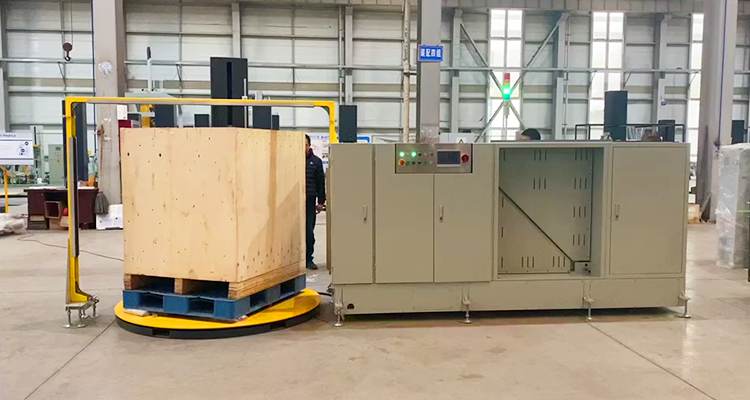
Automatic strapping mechanism reduces ad-hoc manual reinforcement
In some industries — for example beverages, building materials, and chemical drums — pallets wrapped only with film can still wobble or loosen in places and require additional manual strapping to meet transport requirements. After film wrapping, the integrated machine automatically performs strap threading, tensioning, welding and cutting, ensuring the reinforcement step is consistent for every pallet. The machine can be configured for single or double strapping depending on cargo weight, pallet height, and load imbalance, reducing variation introduced by manual reinforcement and making packaging quality more stable and controllable.
Fewer forklift trips, smoother outbound area flow
Under traditional workflows a pallet often has to pass through wrapping, strapping and sometimes temporary reinforcement stations; forklifts may touch the same pallet multiple times, increasing labor costs and compromising onsite safety. The integrated machine concentrates both processes in a single station; with automatic conveying or a one-time forklift placement, the entire packaging is completed, shortening forklift routes and keeping aisles clearer. For factories pursuing automation upgrades, this equipment can be integrated with upstream palletizers or conveyors to form a continuous packaging line.
Adjustable operating parameters adapt to different cargo strength requirements
The machine supports adjustment of film wrap counts, carriage ascent speed, film tension, strap tension, and strap positions so it can adopt appropriate packaging strategies for different pallet constructions. Examples: cartons — increase wrap density for neater stacks; chemical drums — increase strap tension and add bottom reinforcement loops; bagged goods — use higher film tension to even out load forces; mixed loads — use localized reinforcement patterns to reduce wobble. These adjustable parameters let companies tailor packaging to cargo characteristics and improve shipment stability.
Applicable across many industries for reinforcement packaging
This integrated machine is suitable for food & beverage, e-commerce warehousing, chemical raw materials, paper products, home furnishing and building materials, especially where shipment volume is high, pallet types are varied, and packaging stability requirements are strict. In transit warehouses, automated storage, and factory shipping areas, it consolidates wrapping and strapping to make outbound processes more compact and efficient.
Overall benefits: more stable packaging, smoother cycle times, standardized shipments
By reducing pallet handling, improving film adhesion and unifying strap tension, the wrapping-and-strapping integrated machine ensures consistent packaging quality and gives customers greater confidence during transport, storage and handling. The equipment is suitable for continuous high-load operation and fits factories that require stable throughput. For companies moving toward digital management, the machine can serve as a key node in the packaging stage to standardize methods and lay the groundwork for intelligent warehousing and automated logistics.